How Much Rainwater Can Your Roof Collect? Formula and Example
Your roof can collect a surprising amount of rainwater, but potential runoff is different from water you can actually store and use. Estimate the roof area feeding your collection point, the rainfall depth and the losses in the collection system before choosing a tank.
The basic gallons formula
For U.S. customary units, a useful volume calculation is gallons = contributing roof area in square feet × rainfall depth in inches × 0.623. This gives the approximate volume before collection losses. The conversion follows from the volume of water covering one square foot to a depth of one inch.
For example, 1,000 square feet receiving 1 inch of rain produces approximately 623 gallons before losses. If you assume an illustrative collection efficiency of 80%, the captured amount becomes about 498 gallons. The efficiency is an assumption, not a universal value.
Measure the correct catchment
Use the horizontal roof footprint draining to the collection point. If only one roof section feeds the barrel, do not enter the whole house roof area. Do not use floor area or multiply the footprint by roof pitch for this rainfall volume calculation.
The rain harvesting calculator helps compare scenarios. Review the units and assumptions before using an output to choose storage.
Allow for losses and limited storage
Debris screens, first-flush diversion, leakage and overflow can reduce usable collection. A barrel that is already full cannot store the next storm unless water is used or drained between events. Compare rainfall timing with your irrigation needs instead of relying only on an annual rainfall total.
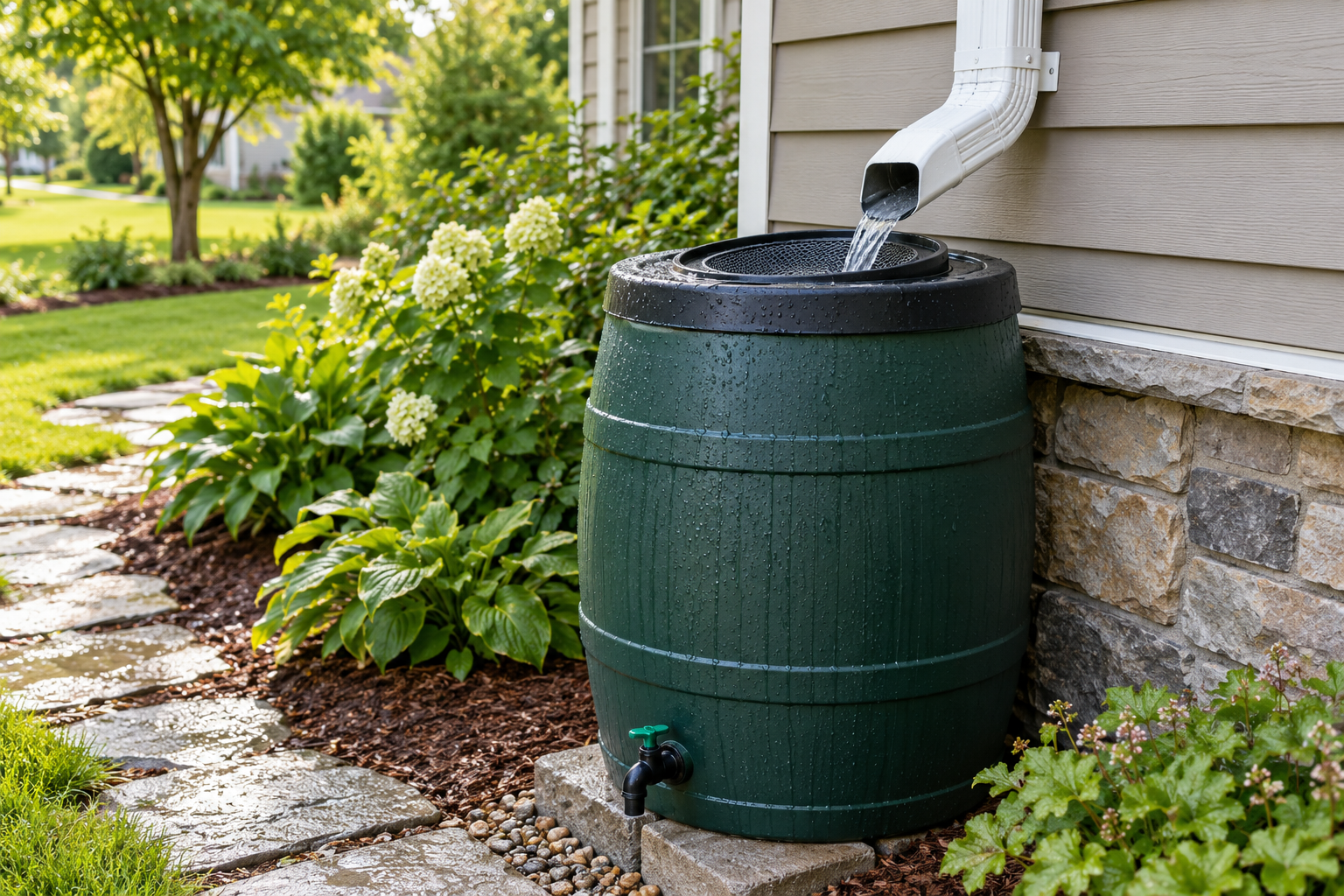
A 55-gallon barrel will fill well before receiving all of the theoretical 623 gallons in the example. Its overflow arrangement therefore matters as much as its nominal storage capacity.
Plan the overflow before connecting the barrel
- Provide a stable base suitable for the full tank weight.
- Use the manufacturer’s screened inlet and secure lid arrangement.
- Route overflow away from the foundation and walking surfaces.
- Keep the system isolated from drinking-water plumbing unless professionally designed and approved.
Roof runoff is not automatically safe to drink. Check local collection rules and suitability for your intended use. Clemson Extension’s rain barrel guide discusses collection sizing and practical system considerations.
Volume is different from peak flow
Storage uses gallons collected over an event. Gutters and downspouts must handle the flow rate during rainfall. For that separate task, use the water runoff calculator and review the downspout planning guide.